
The Difference 30 Years Makes: How the Investing Landscape Has Changed
As the front-page story highlighted, the investing landscape has changed dramatically over recent decades. Here are four ways:
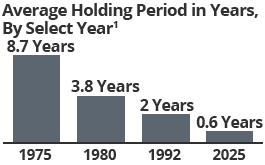 1. Holding periods have become shorter — The average holding period of shares has fallen from roughly 8 years in the 1970s to just 7 months today. Automated exchanges have led to the rise of high-frequency trading using computer algorithms to analyze and execute trades. Retail investors have also become more active due to online trading platforms.
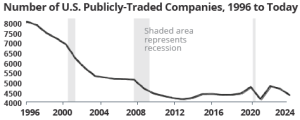 2. Public markets have shrunk — The number of publicly listed companies has declined by roughly 50 percent since the mid-1990s, largely in favour of private markets.2
3. Equity market participation has grown — Lower barriers to entry have 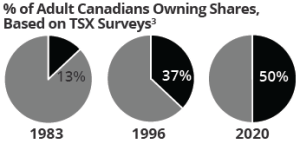 democratized participation. Canada has the second highest equity market participation globally, at roughly 50 percent of households. The U.S. leads at 55 percent, with Australia ranking third at 37 percent.3
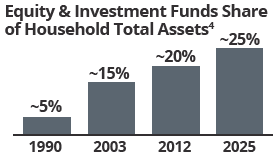 4. Equities account for a greater share of wealth — Alongside rising equity participation, Canadian household wealth has reached new highs. As the saying goes, “a rising tide lifts all boats.“
1. Based on TOTMKUS Index; holding period = 1/turnover ratio; https://www.cibc.com/content/dam/cibc-public-assets/asset-management/pdfs/short-term-orientationof-equity-market-en.pdf#
2. https://data.worldbank.org/indicator/CM.MKT.LDOM.NO?locations=US;https://www.apolloacademy.com/public-equity-markets-have-changed-why-do-portfolios-still-look-the-same/
3. www.visualcapitalist.com/ranked-top-countries-by-stock-market-ownership/; https://www.cbc.ca/news/business/survey-says-almost-half-of-canadian-adults-own-stocks-1.208778
4. https://www.nbc.ca/content/dam/bnc/taux-analyses/analyse-eco/mkt-view/market_view_250313.pdf