
Challenging the Artificial Intelligence Job Apocalypse
Is artificial intelligence (AI) coming for your job? According to The Economist, one in three people believe AI will cause widespread job losses, while seven out of 10 believe it will make it harder for people to find work.
Beyond the geopolitical volatility dominating headlines, the “AI job apocalypse” has become a common narrative. It doesn’t help that the unemployment rate has been creeping upward, and that many recent college and university graduates are struggling to find work.
Of course, there’s no doubt that AI improves productivity. A recent paper from Stanford University examined how large language model tools (generative AI systems known as LLMs) are already significantly improving productivity across a range of knowledge based tasks. The results are striking. In every common work task that was studied, generative AI reduced completion time by at least half, and in most cases by around 70 to 75 percent (chart below). The study also found that LLM adoption among U.S. workers rose significantly from 30.1 percent as of December 2024 to 38.3 percent as of December 2025.1
Given the proven capabilities and rapid advancement of AI, it will undoubtedly eliminate some tasks and compress certain roles. There is evidence that this may already be happening.2 However, the notion that AI will imminently create permanent, widespread unemployment might be exaggerated.
How Many Minutes Does AI Save? Select Work Tasks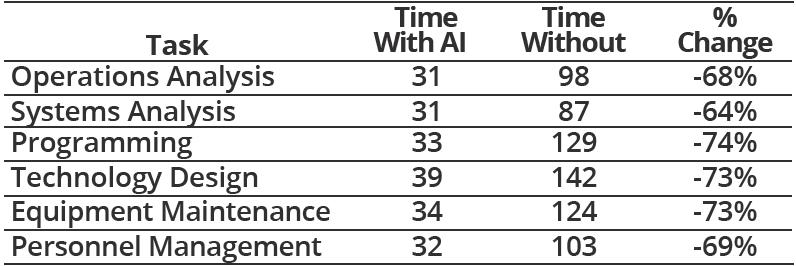
 Historically, productivity gains have often expanded economic activity rather than contracted it, creating new industries, new demand and ultimately new forms of employment. A related dynamic is seen in the Jevons Paradox: efficiency gains lower costs, which tends to increase overall consumption rather than reduce it. William Jevons observed this phenomenon in the 19th century when improvements in efficiency led to greater overall coal consumption, not less.
 We’ve been here before. In 1951, when IBM introduced its electronic calculator, it was promoted as capable of replacing 150 engineers. Yet, 75 years later, engineers remain indispensable. Every major platform shift arrives with the familiar promise and worry: more output, fewer people, instant transformation. In recent decades, similar fears surrounded radiologists, telemarketers and travel agents. In practice, technology augmented these professions rather than eliminating them outright.
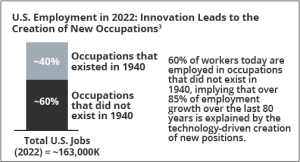
 Then there are the jobs that do not yet exist. One study suggests that technology has facilitated the creation of new occupations that now employ 60 percent of workers today (above). Indeed, the labour market will evolve, as it always has when transformative technologies emerge. But worries of widespread and permanent unemployment may ultimately prove to be a shortsighted view of the world ahead.
1. https://papers.ssrn.com/sol3/papers.cfm?abstract_id=5136877
2. https://fortune.com/2026/04/06/ai-tech-displacement-effect-gen-z-16000-jobs-per-month/
3. https://www.gspublishing.com/content/research/en/reports/2023/03/27/d64e052b-0f6e-45d7-967b-d7be35fabd16.html