
The Power of Slow: Building Wealth Takes Time
“It took 20 years to make an overnight success.”
— Eddie Cantor, Broadway Star
In both life and investing, meaningful achievements rarely happen overnight. From towering sequoias to majestic mountains, some of the universe’s most impressive features emerge gradually, through quiet, persistent growth. The same principle holds true in investing: discipline and time are key ingredients for long-term success.
As we begin another year, after impressive equity market returns in recent years, it may be worth reflecting: Quiet compounding—the gradual, cumulative growth over long periods—may seem unremarkable in the moment, but its impact can be profound. By focusing on long-term growth rather than short-term market noise, investors are better positioned for uncertainty—able to navigate unexpected events without derailing their overarching plan. The following examples illustrate the long-term power of patience:
How Time Can Impact an Investment
It’s worth a reminder that even modest returns, compounded over decades, can create impressive outcomes. Consider what happens to a lump-sum investment of $100,000 left to grow over time:
Impact of Time & Rate of Return on $100,000 Investment

Time matters. Extending the investment horizon from 30 to 50 years can more than double and even triple the outcome at the same rate of return. Even modest changes in the rate of return can be meaningful. A one percent increase in the annual rate of return can significantly enhance wealth over decades.
The takeaway? Patient, consistent investing can be a powerful force.
Compounding at Scale: Companies Built Over Decades
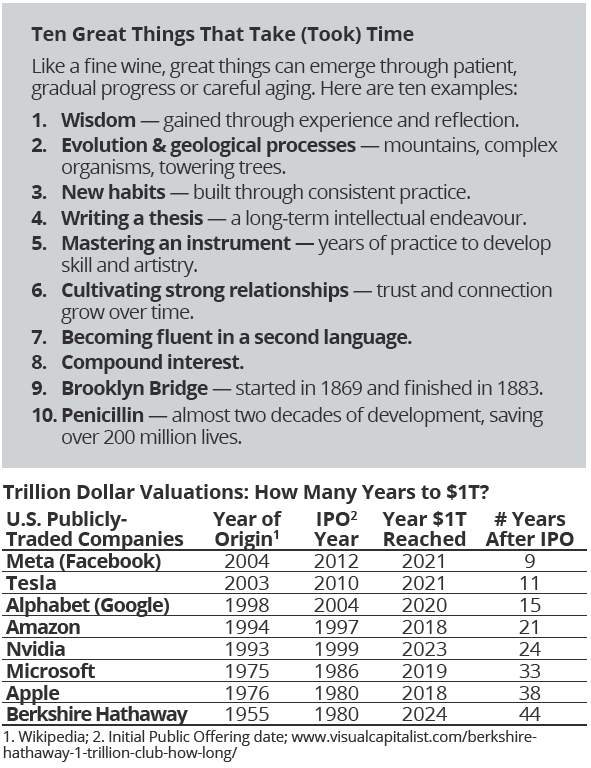
Long-term compounding isn’t just an important tool for individual investors—it’s how the world’s greatest companies have built their valuations. In October 2025, Nvidia became the first U.S. publicly-traded company to reach a $5 trillion market capitalization. Consider that Nvidia’s value is now greater than the GDP of every country, except the U.S. and China, according to the latest World Bank data.
As of November 2025, only 10 U.S. companies have reached the prestigious trillion-dollar market capitalization mark (defined as share price x shares outstanding). Yet this didn’t happen overnight—building meaningful wealth, whether for a corporation or an individual, takes time. Berkshire Hathaway was the first non-tech company to achieve this ranking in 2024, but it relied on nearly six decades of growth. Warren Buffett first took control in 1965, when Berkshire was a struggling textile mill valued at around $22 million. It would take another 15 years before the company went public in 1980, and then another 44 years to reach trillion-dollar status. Buffett credits much of this success to compounding—reinvesting profits into new investments, allowing the company’s value to grow steadily over time.
A Look Ahead to 2026: Where Are Markets Headed?
All of this is to suggest that longer-term investors should not become overly preoccupied with what might happen tomorrow or even in the months ahead. Instead, a more prudent focus is a time horizon measured in years, or even decades. Even retirees can plan with that time horizon in mind, given our increasing longevity. A lot can happen over 10 years, and one of the best ways for investors to continue benefiting is to continue participating. Look ahead with confidence!
Note: This article is not intended to provide investment recommendations. It highlights the power of compounding and the patience needed to achieve meaningful growth.